Wayfinding, Memory Cues and Landmarks
Overview: Wayfinding, Memory Cues & Familiar Landmarks
At Windchime of Marin, our Memory Care Trained Teams utilize the physical environment as a powerful caregiving tool through strategic Wayfinding, Memory Cues & Familiar Landmarks. By leveraging personalized memory boxes, color-coded neighborhoods, continuous pathways, and the stunning natural backdrop of Kentfield, our staff empowers residents to navigate their home safely and independently. This thoughtful integration of architectural design and specialized staff training drastically reduces anxiety and fosters a profound sense of security and belonging.
The Architecture of Care: Wayfinding, Memory Cues & Familiar Landmarks at Windchime of Marin
When we think of a "caregiver," we typically picture a compassionate nurse or a dedicated aide. However, in the realm of specialized Alzheimer's and dementia support, there is another, equally critical caregiver: the building itself. Spatial disorientation—the inability to determine one's location or navigate a space—is one of the hallmark, and most distressing, symptoms of cognitive decline. A hallway that a resident has walked down a hundred times can suddenly appear entirely unfamiliar, leading to profound anxiety, frantic pacing, and a terrifying sense of being lost.
At Windchime of Marin, an exclusive memory care community nestled in the serene community of Kentfield, California, we do not expect our residents to adapt to a standard, institutional building. Instead, our facility was specifically designed to adapt to the dementia brain. Under our overarching amenity category of Memory Care Trained Teams, we recognize that our staff cannot be everywhere at once. Therefore, they are trained to utilize the building's specialized design—specifically Wayfinding, Memory Cues & Familiar Landmarks—to help residents navigate their day with confidence, dignity, and maximum independence.
The Psychological Toll of Disorientation
To understand the importance of wayfinding, one must understand the panic of disorientation. Imagine waking up in a hotel room in a foreign city and not knowing where the bathroom is, or trying to find the lobby but only encountering identical, endless corridors. For a person with dementia, this panic is a daily reality.
When a resident feels lost, their brain often triggers a "fight or flight" response. This manifests as behavioral agitation, combativeness, or elopement attempts (trying to leave the building to "go home"). Standard assisted living facilities often exacerbate this issue with complex layouts, uniform paint colors, and long, dead-end hallways. Windchime of Marin takes the exact opposite approach, employing environmental psychology to create a space that naturally guides, rather than confuses.
Featured Amenity: Intelligent Wayfinding and Memory Cues
Our highly trained staff works in tandem with the physical environment to empower our residents. We utilize a multi-layered approach to wayfinding that engages visual, tactile, and spatial recognition.
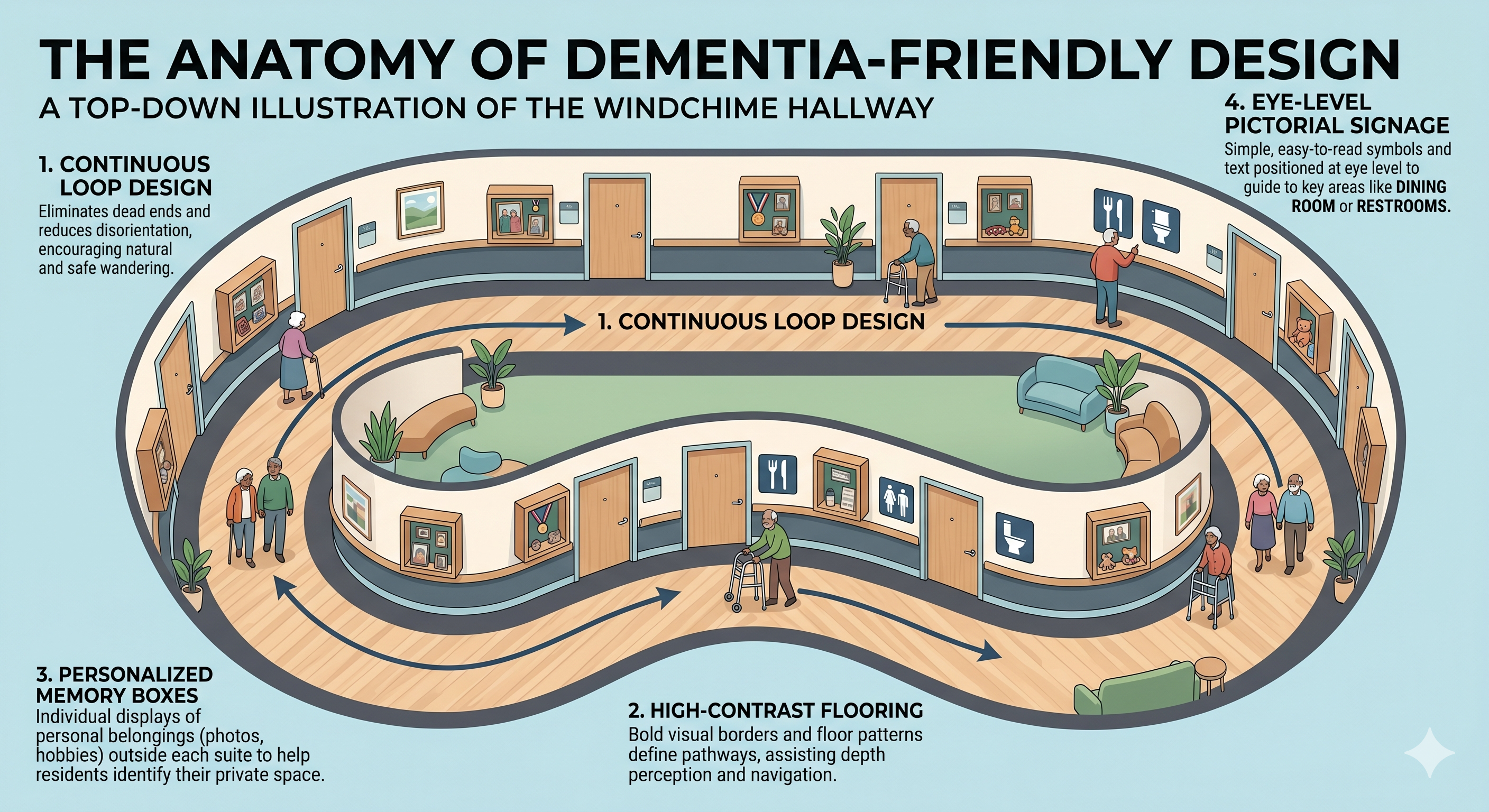
- Personalized Memory Boxes at Suite Entrances: Memory loss typically affects short-term recall first, while long-term memories from early adulthood remain robust. A resident may not remember that their room number is 104, but they will recognize a photograph from their wedding day. Outside every private suite at Windchime is a dedicated "memory box" or display case. Our staff works with families to fill these boxes with cherished items—vintage photographs, military insignia, a favorite piece of jewelry, or a beloved knick-knack. These personalized landmarks serve as a comforting homing beacon, allowing residents to independently and confidently identify their own safe space.
- Color-Coded Neighborhoods and Hallways: As dementia progresses, the brain struggles to process complex spatial layouts, but it can still distinguish bold colors. Our community is divided into smaller, intimate "neighborhoods," each utilizing distinct, high-contrast color palettes. A resident may not know they are in the "West Wing," but they will know that their room is in the "Blue Hallway." Our trained teams use these color cues verbally: "Let's walk down the blue path to your room."
- High-Contrast Lighting and Flooring: Aging eyes and dementia alter depth perception. A dark shadow on the floor can look like a terrifying hole, and a white toilet against a white bathroom wall can become invisible. We utilize high-contrast materials to define spaces. Darker floors contrast sharply with lighter walls to clearly indicate boundaries. Bathrooms feature contrasting grab bars and toilet seats. Furthermore, our maintenance and care teams ensure that lighting is bright, even, and free of glare or shadows that could cause hesitation or falls.
- Continuous, Circular Facility Layout: Dead ends are the enemy of dementia care. When a resident who is pacing (a common self-soothing behavior) hits a dead end, they often become trapped, confused, and agitated. The layout at Windchime of Marin features continuous, flowing pathways. Hallways gently loop back into active, engaging common areas like the dining room or the living room. This allows residents to walk safely and continuously without ever feeling trapped, while our staff monitors them unobtrusively.
- Dementia-Friendly Signage: We do not rely solely on text. Our signage features bold, easy-to-read lettering accompanied by clear, universally recognized pictorial icons—such as a picture of a plate and fork pointing toward the dining room, or a toilet icon for the restroom. These signs are placed at eye level, taking into account the downward gaze common in older adults
Integrating the Marin Landscape as a Landmark
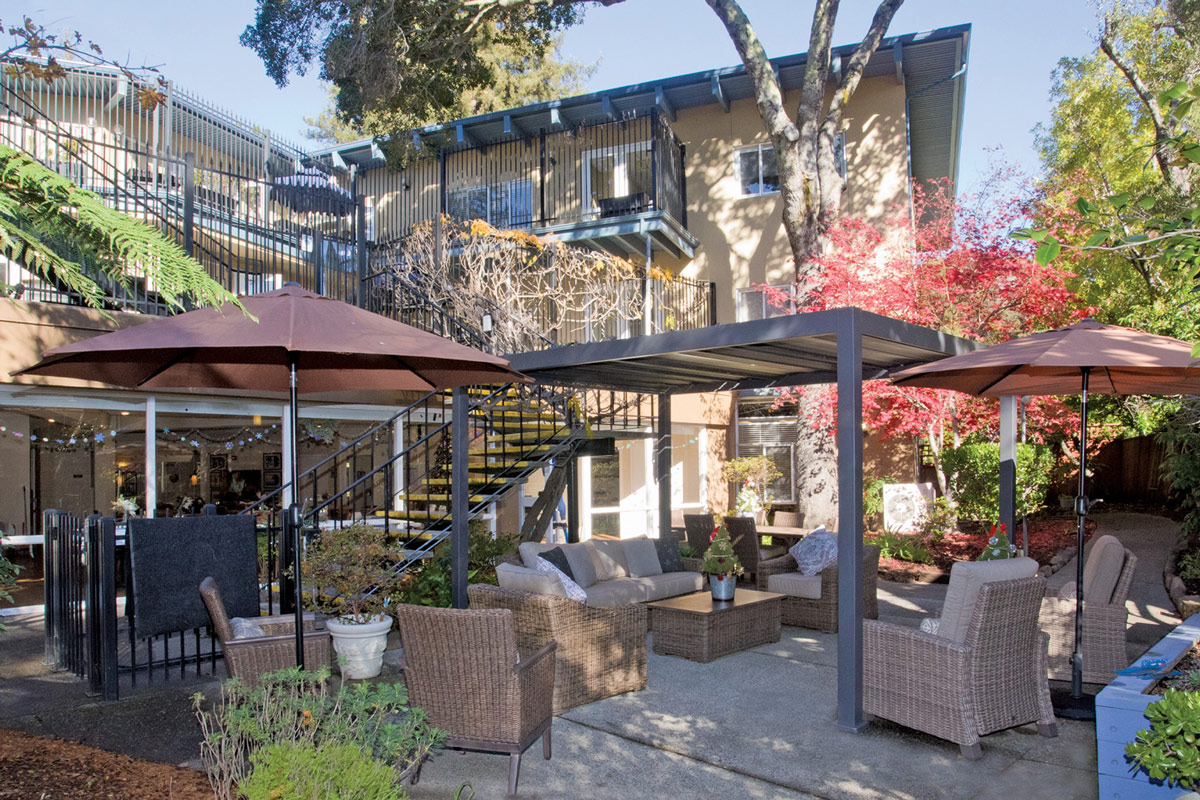
Wayfinding is not limited to the interior of the building. We believe in utilizing the breathtaking natural beauty of Kentfield to orient our residents. Large, strategically placed windows flood our corridors with natural light, helping to regulate circadian rhythms and giving residents a sense of the time of day.
Furthermore, our secure outdoor courtyards are designed with clear sightlines to local geographic landmarks, most notably the majestic silhouette of Mount Tamalpais. For residents who have spent their lives in Marin County, seeing "Mount Tam" is a profound, comforting anchor to reality. It provides spatial and geographic orientation, reminding them that they are safe, they are home, and they are in the beautiful Bay Area they have always loved.
(Placeholder: [Infographic: The Anatomy of Dementia-Friendly Design – A top-down illustration of a Windchime hallway, pointing out the continuous loop design, the high-contrast flooring, the eye-level pictorial signage, and the personalized memory boxes outside each suite door.])
The Role of the Trained Team
Environmental cues are only half of the equation; the other half is our Memory Care Trained Teams. Our staff does not just passively watch residents navigate; they actively use the building as a therapeutic tool. If a resident seems lost, a trained caregiver will not just grab their arm and pull them. Instead, they will walk alongside them, gently pointing out the memory cues: "Look at this beautiful picture of your daughter in the memory box here; this is your lovely room."
By combining an intelligently designed environment with a deeply educated, compassionate staff, Windchime of Marin transforms a confusing world into a manageable, empowering home. We remove the anxiety of being lost, allowing our residents to focus on living, engaging, and experiencing joy.
Frequently Asked Questions (FAQs)
What is a memory box"?
A memory box is a small, secure display case located just outside a resident's private suite. Families fill it with recognizable, cherished items from the resident's past (like vintage photos or hobbies). Because long-term memory is often preserved, these items help the resident easily and independently identify their room.
Why are there no dead-end hallways at Windchime?
Dead ends can cause panic and frustration for a person with dementia who is walking or pacing. When they hit a wall, they may not know how to turn around and navigate back. Our continuous, circular pathways allow residents to walk safely and always end up back in a comforting common area.
How does color contrast help someone with Alzheimer's?
Dementia and aging can severely impair depth perception and spatial awareness. Using high-contrast colors (e.g., dark floors against light walls, or a brightly colored toilet seat against a white floor) helps the brain easily distinguish boundaries, reducing the risk of falls and increasing independence in the bathroom.
Are residents allowed to go outside independently?
Yes! Our beautiful outdoor courtyards in Kentfield are fully secure. The pathways are designed to be safe and easily navigable, allowing residents to independently enjoy the fresh air, sunshine, and views of Mount Tamalpais without the risk of wandering off the property.
What if my loved one still gets lost inside the building?
Our staff is highly trained in behavioral observation. Because our facility has clear sightlines, our team can unobtrusively monitor residents. If someone appears confused, a caregiver will gently approach them, use validation techniques to calm any anxiety, and use the environmental cues (like color coding or signage) to guide them to their destination.
Do I have to provide the items for the memory box?
Yes, we rely on families to provide these items, as you know your loved one's history best! We recommend choosing items from their early adulthood or middle age, as these memories are typically the strongest and most recognizable to them now.