24-7 Trained Staff Presence
SUMMARY
At Windchime of Marin, our 24/7 trained staff presence provides families with the ultimate peace of mind, knowing their loved ones are in capable, compassionate hands at all hours. Located in the peaceful community of Kentfield, our highly trained caregivers specialize in dementia support, offering continuous monitoring, rapid emergency response, and deeply personalized care. We ensure a secure, nurturing environment throughout Marin County, day and night, so families can finally rest easy.
The Anchor of Safety: 24/7 Trained Staff Presence at Windchime of Marin; The Ultimate Peace of Mind for Families
When families serve as primary caregivers for a loved one with Alzheimer's disease or a related dementia, the most exhausting element is rarely the physical labor; it is the hyper-vigilance. The constant, gnawing worry of what might happen if you look away for a moment or fall into a deep sleep is incredibly draining. Wandering, fall risks, and sudden medical emergencies are terrifying realities of cognitive decline.
When you make the decision to transition your loved one to Windchime of Marin, you are not just securing a new home for them; you are securing profound peace of mind for yourself. The foundation of our Safety, Security & Emergency Response philosophy is our unwavering, 24/7 Trained Staff Presence. Located in the serene environment of Kentfield, California, our community operates around the clock. We provide a safety net that never sleeps, ensuring that the residents of Marin County receive continuous, compassionate, and highly skilled care every single minute of the day and night.
Key Features of Our 24/7 Staffing Model
The phrase "24/7 care" is often used broadly, but in a dedicated memory care setting, it requires specific, intentional structuring to be truly effective. Here is how we ensure comprehensive safety through our staffing model:
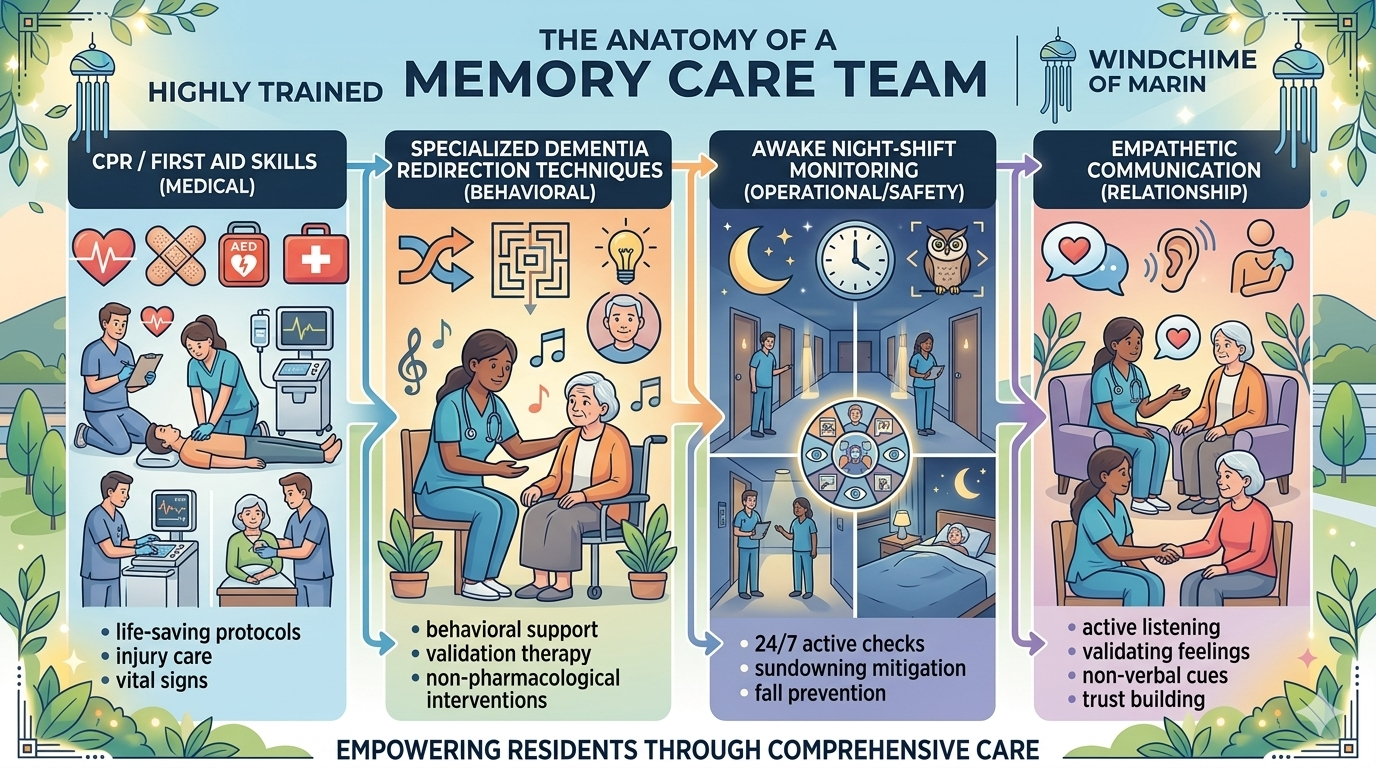
- Around-the-Clock Compassionate Care: Dementia does not adhere to a standard business schedule. In fact, many individuals with memory loss experience disrupted circadian rhythms, leading to wakefulness, confusion, or anxiety in the middle of the night. At Windchime of Marin, our night shifts are staffed by awake, alert, and fully engaged care professionals. If a resident wakes up at 3:00 AM feeling disoriented, they are not met with an empty hallway. They are immediately greeted by a warm, familiar face offering a comforting cup of warm milk, a gentle conversation, and a safe escort back to bed. This continuous monitoring drastically reduces the risk of nighttime falls and unobserved wandering.
- Specialized Dementia & Alzheimer’s Training: Having staff present is only half the equation; having trained staff is where true safety lies. Every member of our care team undergoes rigorous, ongoing training specifically focused on the nuances of neurocognitive decline.
- Understanding Non-Verbal Cues: In the later stages of dementia, residents may lose the ability to articulate pain, fear, or urgent biological needs. Our staff is trained to read subtle body language and behavioral changes that indicate distress, allowing us to address issues before they escalate.
- De-escalation and Redirection: If a resident becomes agitated or experiences a catastrophic reaction, our staff utilizes specialized validation therapy and redirection techniques. Instead of arguing or using physical restraint, they calmly enter the resident's reality, validate their feelings, and gently guide their attention to a soothing activity. Rapid Emergency Response & Medical Coordination: Emergencies, whether a sudden fall, a cardiac event, or a severe behavioral crisis, require immediate, decisive action. Because our staff is always present and continuously monitoring the environment, response times are virtually instantaneous.
- On-Site Readiness: Our team is trained in CPR, First Aid, and emergency protocols specific to the frail elderly. We maintain clear, rapid communication channels between care staff, nursing directors, and administration.
- Local Medical Integration: Should an acute medical emergency arise that requires hospitalization, our team acts as immediate liaisons. We coordinate seamlessly with emergency responders and local medical facilities, such as the nearby MarinHealth Medical Center. We ensure that paramedics are briefed on the resident's complete medical history, current medications, and baseline cognitive status, which is crucial information that the resident may not be able to provide themselves. Familiarity and Consistent Caregiving: Routine and familiarity are the antidotes to the confusion of dementia. We strive for high staff retention and consistent scheduling. When a resident sees the same caregivers day after day and night after night, it builds a profound sense of trust and security. Furthermore, consistent staffing means our team intimately knows each resident’s "baseline." They know what a resident's normal gait looks like, what their normal appetite is, and how they usually react to certain stimuli. This deep familiarity allows our staff to immediately spot minute deviations that could indicate a silent infection (like a UTI) or a developing medical issue, catching problems long before they become emergencies.
Navigating the Night: Sundowning and Sleep Disruptions
To truly understand the value of a 24/7 trained staff presence, one must understand the unique nighttime challenges of dementia. "Sundowning"—a state of increased confusion, anxiety, and agitation that begins in the late afternoon and stretches into the night—is incredibly common.
For a family caregiver at home, managing sundowning is often a breaking point. It leads to severe sleep deprivation for the caregiver and a high risk of injury for the resident. At Windchime of Marin, our evening and night staff are specifically prepared for this phenomenon. We utilize environmental controls—such as gradually dimming lights to signal evening, maintaining a quiet atmosphere, and offering soothing sensory activities—to mitigate the effects of sundowning.
If a resident cannot sleep, our staff is there to provide quiet companionship. They might sit together in the Restorative Calm & Reflection Zone, read a book aloud, or quietly listen to soft music until the resident feels tired enough to safely return to sleep. This specialized, patient approach to nighttime care is what separates a dedicated memory care community from standard assisted living.
The decision to move a loved one into memory care is heavy. However, the transformation we see in families once the transition is complete is remarkable.
When you live in Kentfield, or anywhere in Marin County, and you know that your loved one is residing at Windchime of Marin, the crushing weight of hyper-vigilance is lifted. You no longer have to worry about the stove being left on, the front door being left unlocked, or a devastating fall occurring while you are at the grocery store.
Our 24/7 trained staff presence absorbs that burden. By taking on the role of protectors, medical coordinators, and nighttime companions, we free you to return to your primary role: being a loving family member. You can visit our community, enjoy a meal together, take a walk through our secure courtyards, and leave at the end of the day knowing they are safe, secure, and deeply cared for until you return.
Frequently Asked Questions (FAQs)
What does it mean to have "awake" night staff? In some standard care settings, night staff may be allowed to sleep unless called. In our memory care community, "awake" staff means our caregivers are actively up, conducting regular rounds, monitoring hallways, and ready to immediately assist any resident who wakes or wanders during the night.
What specialized dementia training does your staff receive? Our staff undergoes rigorous training that covers the pathology of dementia, effective communication strategies for non-verbal residents, behavioral de-escalation, validation therapy, and how to safely assist with physical mobility to prevent falls.
What happens if my loved one has a medical emergency in the middle of the night? Because our staff is always present and monitoring, they will respond immediately. They are trained in First Aid and CPR, will initiate our emergency protocols, contact 911 if necessary, and communicate directly with local Marin County hospitals and your family simultaneously.
How do you monitor residents without being overly intrusive? We balance safety with dignity. Our staff conducts regular, quiet checks throughout the night. We also utilize architectural features—like clear lines of sight from staff hubs down the hallways—to keep a watchful eye on the environment without disturbing a sleeping resident.
Are there nurses on staff 24/7? While we have highly trained caregivers present 24/7, our nursing staff (such as an LVN or RN) manages clinical care plans, oversees medication administration protocols, and is either on-site during designated hours or available strictly on-call 24/7 for clinical emergencies. (Note: Specific nursing hours vary by facility regulations, but clinical oversight is always continuous).
How does consistent staffing help with safety? When caregivers work with the same residents consistently, they learn the resident's "baseline" health and behavior. This allows them to quickly notice subtle changes—like a slight limp, a change in breathing, or unusual confusion—that might indicate an underlying medical issue like a UTI, allowing for rapid intervention.
Citations:
• Alzheimer's Association: Safety and Wandering Prevention in Dementia Care.
• National Institute on Aging: Caregiver Guide to Alzheimer's Disease and Sleep Issues.
PDF Download: Peace of Mind Safety at Windchime