
Individualized Care Plans
SUMMARY
At Windchime of Marin, we understand that dementia is a uniquely personal journey, which is why our Personalized Care & Support relies entirely on Individualized Care Plans. By combining comprehensive medical and behavioral assessments with a deep understanding of each resident's life story, and executing these plans through the power of Consistent Care Teams, we ensure that every individual receives the precise support they need to thrive with dignity in our Kentfield community.
The Blueprint of Dignity: Individualized Care Plans at Windchime of Marin
When a family is searching for a memory care community, one of their greatest underlying fears is that their loved one will become just another number—that their unique personality, their lifelong habits, and their deeply personal needs will be lost in a sea of institutional routine. Alzheimer's disease and other forms of dementia may slowly erode memory, but they do not erase the essence of the person.
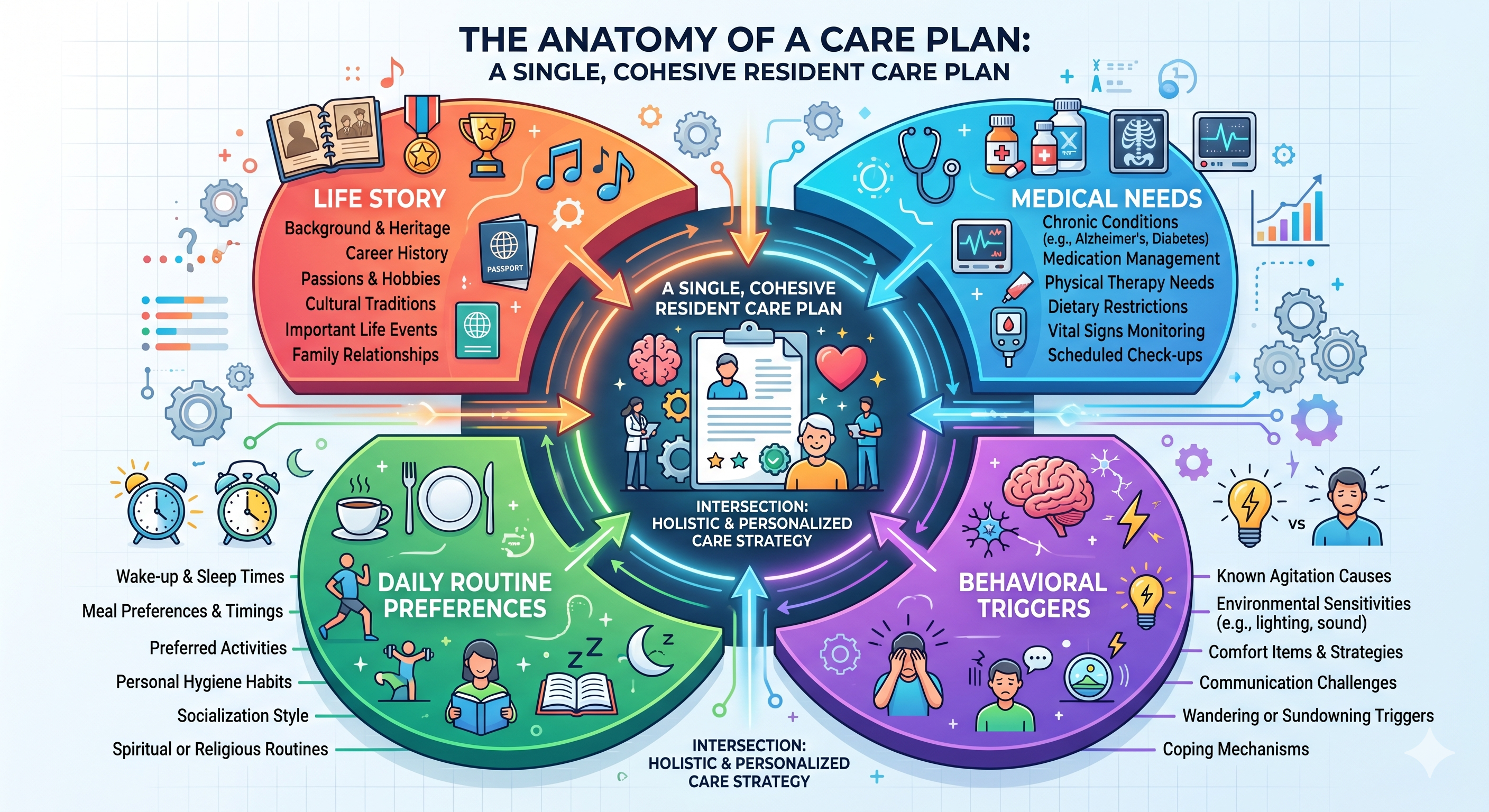
At Windchime of Marin, beautifully situated in the heart of Kentfield, California, we reject the "one-size-fits-all" approach to senior living. Within our overarching category of Personalized Care & Support, the driving force behind our daily operations is the Individualized Care Plan. This dynamic, highly detailed roadmap ensures that we are caring for the whole person—their medical realities, their emotional needs, and their rich personal history—rather than simply managing a diagnosis.
What is an Individualized Care Plan?
An Individualized Care Plan is far more than a simple chart detailing when to administer medication or what time to serve dinner. It is a comprehensive, living document that dictates how our entire staff interacts with, supports, and engages a resident throughout their day.
Before a resident even unpacks their bags in our Marin County community, our clinical directors and nursing staff sit down with the family to conduct a deep, multi-faceted assessment. We gather crucial medical data, evaluate fall risks, assess mobility challenges, and document dietary needs. But the clinical data is only half of the equation.
We also conduct a "Life Story" interview. We want to know who the resident was before the cognitive decline began. Were they an avid hiker who spent weekends on the trails of Mount Tamalpais? Were they an early riser who loved reading the morning paper with a black coffee? Did they have a long career as a teacher in the local school district? We weave these vital personal details directly into their care plan. If a resident becomes agitated in the late afternoon, their care plan might instruct a caregiver to play their favorite classical composer or ask them for "help" sorting a deck of cards—utilizing their personal history to provide comfort and non-pharmacological redirection.
The most brilliantly designed care plan in the world is useless if the people implementing it are constantly changing. High staff turnover and rotating shifts are common in the broader healthcare industry, resulting in disjointed care and heightened anxiety for dementia patients who struggle to process new faces.
At Windchime of Marin, we solve this through the implementation of Consistent Care Teams. This is a cornerstone of our Individualized Care Plans and a hallmark of our community structure.
- Building Profound Trust: We assign the same dedicated group of caregivers, nurses, and medication technicians to the same residents day after day. For a person with Alzheimer's, routine and familiarity are the ultimate anchors of safety. When a resident sees the same warm, smiling face every morning to help them dress, the fear and resistance often associated with personal care melt away. They are not being assisted by a stranger; they are being supported by a trusted friend.
- Recognizing Subtle Shifts in Baseline: Dementia care requires acute observation. Because our Consistent Care Teams spend so much time with their specific residents, they become intimately familiar with their "baseline" behavior. If a resident who is normally talkative during breakfast is suddenly quiet, or if their gait seems slightly off while walking down the hall, a consistent caregiver will notice this subtle shift immediately. This allows our clinical team to intervene early—perhaps catching a minor urinary tract infection before it escalates into a hospital visit, or adjusting a pain medication promptly.
- Mastering the Nuances of the Care Plan: A consistent caregiver doesn't need to read a chart to know that Mrs. Smith prefers her tea lukewarm, or that Mr. Johnson needs gentle verbal cueing to use his walker. They have memorized the nuances of the Individualized Care Plan because they live it every day. They know exactly how to interpret a resident's non-verbal cues and can anticipate their needs, preserving the resident's dignity and significantly reducing frustration.
- Adapting to the Journey
Dementia is not a static condition; it is progressive. A care plan that works perfectly in the spring may need significant adjustments by the autumn.
Because we utilize Consistent Care Teams, we are constantly gathering real-time data on how a resident is functioning. We hold regular, scheduled care conferences with the family to review the Individualized Care Plan. If a resident's mobility has declined, we adjust the plan to include more physical support and perhaps transition them to a puréed diet if swallowing has become difficult. Conversely, if a resident is thriving in an art therapy class, we might adjust their plan to ensure they have more opportunities for creative expression.
Our beautifully designed facility in Kentfield supports this adaptability. Our secure neighborhoods allow residents to move freely and safely, and our care plans dictate the level of "scaffolded" support required to let them enjoy the courtyards and common areas with maximum independence.
By grounding our daily operations in deeply detailed Individualized Care Plans and executing them through loving, Consistent Care Teams, Windchime of Marin ensures that your loved one’s story is honored, their safety is guaranteed, and their quality of life is elevated every single day.
Frequently Asked Questions (FAQs)
What is an Individualized Care Plan? An Individualized Care Plan is a comprehensive, personalized roadmap that details a resident’s specific medical needs, daily routine preferences, behavioral triggers, and personal history. It guides our staff in how to best support, engage, and care for your loved one every day.
How often are these care plans updated? Care plans are living documents. They are formally reviewed during regular family care conferences (typically every 90 days or semi-annually), but they are updated immediately whenever there is a significant change in the resident's physical health, cognitive status, or behavioral baseline.
What does "Consistent Care Teams" mean? Instead of rotating staff randomly throughout the building, we assign the same dedicated group of caregivers and nurses to the same residents. This fosters deep trust, reduces anxiety for the resident, and allows our staff to intimately learn your loved one's specific needs and non-verbal cues.
How does the staff know my loved one's personal history? Upon moving into Windchime of Marin, we sit down with the family to complete a "Life Story" assessment. We ask about their career, hobbies, favorite foods, family background, and lifelong habits. We weave these details directly into the care plan so our staff can spark meaningful conversations and provide personalized comfort.
Can family members contribute to the care plan? Absolutely. We view family members as our most vital partners in care. You know your loved one better than anyone else. Your insights into their past, their preferences, and their personality are the foundation upon which we build the Individualized Care Plan.
What happens if my loved one's dementia progresses and they need more help? Because we actively monitor our residents through Consistent Care Teams, we quickly identify when a resident requires more assistance. We will hold a care conference with you to discuss these changes and adjust the Individualized Care Plan to seamlessly provide the increased level of support (such as mechanical lifts for transfers or feeding assistance) they require.
Citations:
• Alzheimer's Association: Person-Centered Care Guidelines and Assessments.
• National Institute on Aging (NIA): Alzheimer's Caregiving: Providing Daily Care and Monitoring Changes.
PDF Download: Individualized Care Plans